
Introduction
VO2 max is one of the most talked-about numbers in fitness. Smartwatches estimate it, endurance coaches build programmes around it, and research links it to long-term health. But what does it actually measure, and can you improve it?
In simple terms, VO2 max is the maximum rate at which your body can take in, transport and use oxygen during hard exercise. It reflects how well your heart, lungs, blood and muscles work together.
This guide explains the physiology behind VO2 max, why it matters for both performance and health, and what the research says about the most effective ways to raise it.
What Is VO2 Max?
VO2 max stands for maximal oxygen uptake. It is usually expressed in millilitres of oxygen per kilogram of body weight per minute (mL/kg/min), which allows people of different sizes to be compared. It can also be reported as an absolute value in litres per minute.
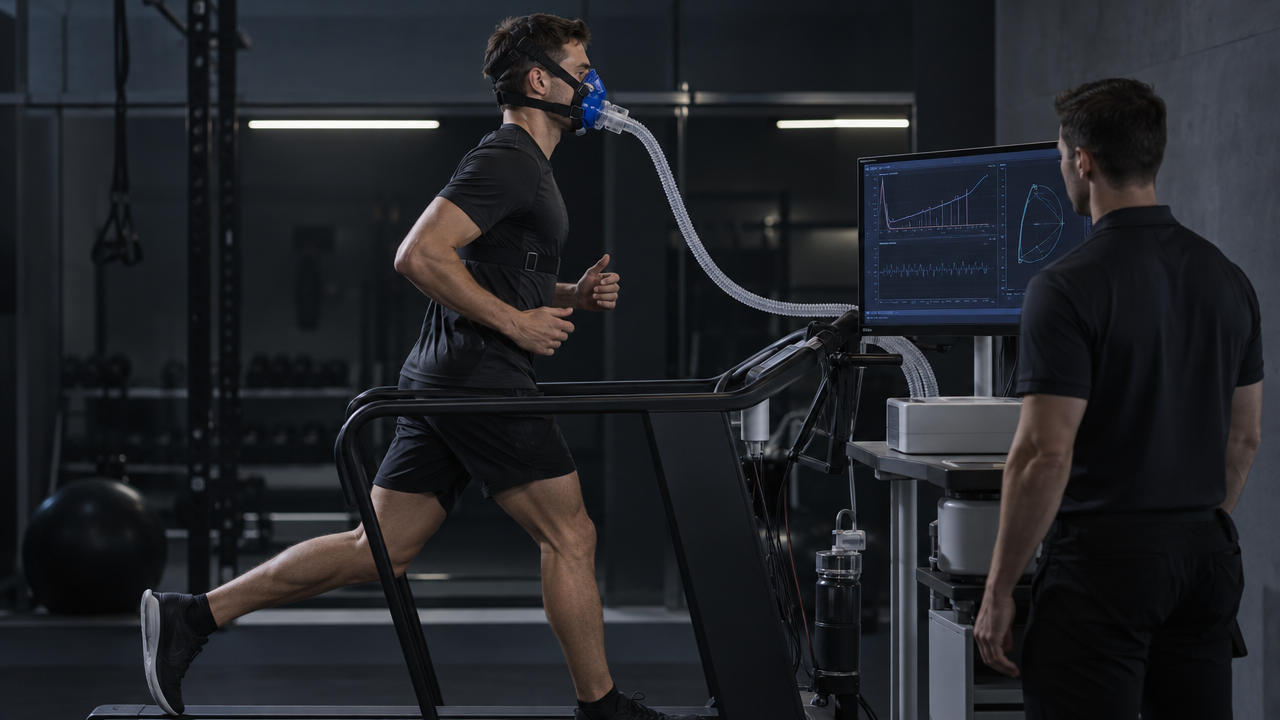
It is measured most accurately in a laboratory during a graded exercise test on a treadmill or bike. Intensity rises step by step while a mask analyses the air you breathe in and out, until oxygen uptake stops rising or you can no longer continue.
Field tests, gym equipment and wearables can only estimate VO2 max from heart rate, pace or power. These estimates are useful for tracking trends, but they are less precise than a lab test.
A higher VO2 max gives you a bigger aerobic engine, but endurance performance also depends on other factors such as how efficiently you move and how much of your VO2 max you can sustain. Two athletes with the same VO2 max can perform very differently.
What Limits VO2 Max?
Oxygen has to pass through a chain of steps: breathing it into the lungs, loading it into the blood, pumping that blood to the muscles, and using it inside the muscle cells. Any of these could, in theory, cap your VO2 max.
A classic review in Medicine & Science in Sports & Exercise by Bassett and Howley concluded that oxygen delivery, not the muscles’ ability to extract oxygen, is the primary limiting factor for VO2 max in exercising humans.
- 70–85% of the limitation in VO2 max linked to maximal cardiac output (Bassett & Howley)
- 70.1 vs 56.5 mL/kg/min VO2 max in highly trained vs normal subjects in one study cited by the review
- 3.15 → 3.68 L/min VO2 max change after 16 weeks of training in one study cited by the review
The same review explains that training-induced gains in VO2 max come mainly from a higher maximal cardiac output, meaning the heart pumps more blood per minute at maximum effort, rather than from muscles extracting a much larger share of the oxygen delivered.
Why VO2 Max Matters for Health
VO2 max is not only a performance marker. Cardiorespiratory fitness, which VO2 max measures directly, is strongly linked to health outcomes.
A meta-analysis in JAMA by Kodama and colleagues pooled 33 studies, with 102,980 participants in the all-cause mortality analysis. Each 1-MET higher maximal aerobic capacity was associated with roughly 13% lower risk of death from any cause and roughly 15% lower risk of coronary heart disease or cardiovascular events.
A later study by Mandsager and colleagues followed 122,007 patients who had treadmill exercise testing. As summarised by the American College of Cardiology, mortality fell as fitness rose, elite performers had the lowest risk-adjusted mortality, and there was no evidence of a U-shaped curve at the highest fitness levels.
These studies are observational, so they show strong associations rather than proof that raising VO2 max alone causes longer life. Still, they make a clear case for improving aerobic fitness.
How to Improve VO2 Max With Training
Both steady endurance training and high-intensity interval training (HIT or HIIT) can raise VO2 max. A meta-analysis by Milanović, Sporiš and Weston in Sports Medicine pooled 28 studies with 723 participants, whose average age was about 25.
| Comparison | Average VO2 max effect | Interpretation |
|---|---|---|
| Endurance training vs no exercise | +4.9 mL/kg/min | Possibly large benefit |
| HIT vs no exercise | +5.5 mL/kg/min | Likely large benefit |
| HIT vs endurance training | +1.2 mL/kg/min in favour of HIT | Possibly small extra benefit |
The practical message: you can improve VO2 max with either approach, and adding some well-structured intervals may give a small extra boost. Note that most participants in these trials were young adults, so results may differ in other groups.
Meeting the baseline guidelines
The American College of Sports Medicine position stand recommends moderate-intensity cardiorespiratory exercise for at least 30 minutes on at least 5 days per week (at least 150 minutes weekly), or vigorous exercise for at least 20 minutes on at least 3 days per week (at least 75 minutes weekly), or a combination of both.
A sample week for improving VO2 max
The example below is a general illustration for a healthy, already active adult, not an individual prescription. If you train outdoors in the UAE, read our guide to heat acclimatization before adding hard sessions in hot weather, or use online coaching to have your plan adjusted for you.
- Day 1: interval session, for example several hard efforts of a few minutes each with easy recovery between them.
- Day 2: easy aerobic session or rest.
- Day 3: steady endurance session at a comfortable, conversational effort.
- Day 4: strength training.
- Day 5: second interval session or a tempo effort.
- Day 6: longer easy endurance session.
- Day 7: rest and recovery.
High-intensity intervals place a big load on the heart. If you are new to exercise, have a heart or medical condition, take regular medication or experience chest pain, dizziness or unusual breathlessness, speak to a doctor before starting vigorous training.
Why Some People Improve More Than Others
If a training partner improves faster than you on the same plan, genetics may be part of the reason. Research from the HERITAGE Family Study, published by Bouchard and colleagues in the Journal of Applied Physiology, estimated the heritability of VO2 max gains with training at 47% in 473 sedentary adults from 99 families.
In the same paper, a panel of 21 genetic variants accounted for 49% of the variance in VO2 max trainability. People carrying 9 or fewer favourable variants improved by an average of 221 mL/min, while those carrying 19 or more improved by 604 mL/min.
This does not mean low responders cannot benefit. It means progress varies, and adjusting training volume, intensity and recovery to the individual matters. Recovery is part of that equation, as explained in our guide to exercise recovery and fatigue.
Key Takeaways
- VO2 max is the maximum rate at which your body can take in and use oxygen during exercise.
- Oxygen delivery, driven largely by maximal cardiac output, is the main limiter of VO2 max.
- Higher cardiorespiratory fitness is strongly associated with lower risk of death and cardiovascular disease.
- Both endurance training and interval training raise VO2 max, with intervals giving a small extra benefit on average.
- Genetics influence how much you improve, so individualised training matters.
Frequently Asked Questions
What is a good VO2 max?
It depends on age, sex and training background. In one study cited by Bassett and Howley, highly trained subjects averaged 70.1 mL/kg/min compared with 56.5 mL/kg/min in normal subjects. Rather than chasing a single number, track your own trend over time.
Is HIIT or steady cardio better for VO2 max?
Both work. In a meta-analysis of 28 studies, interval training improved VO2 max by about 5.5 mL/kg/min versus 4.9 mL/kg/min for endurance training, with a small extra benefit of about 1.2 mL/kg/min for intervals.
How accurate is my smartwatch VO2 max?
Wearables estimate VO2 max from heart rate and pace or power rather than measuring oxygen directly. They are useful for following trends, but a laboratory test with gas analysis is the most accurate measure.
Why does VO2 max matter if I’m not an athlete?
A large meta-analysis found each 1-MET higher aerobic capacity was linked to about 13% lower risk of death from any cause. Aerobic fitness is a strong marker of long-term health, not only sports performance.
Can everyone improve their VO2 max?
Most people improve with training, but the size of the gain varies. Research from the HERITAGE Family Study estimated that around 47% of the variation in training response is heritable.
Sources
- Limiting factors for maximum oxygen uptake and determinants of endurance performance. Medicine & Science in Sports & Exercise, 2000.
- Cardiorespiratory Fitness as a Quantitative Predictor of All-Cause Mortality and Cardiovascular Events in Healthy Men and Women: A Meta-analysis. JAMA, 2009.
- Cardiorespiratory Fitness and Long-Term Mortality. American College of Cardiology, 2019.
- Effectiveness of High-Intensity Interval Training (HIT) and Continuous Endurance Training for VO2max Improvements: A Systematic Review and Meta-Analysis of Controlled Trials. Sports Medicine, 2015.
- Quantity and quality of exercise for developing and maintaining cardiorespiratory, musculoskeletal, and neuromotor fitness in apparently healthy adults: Guidance for prescribing exercise. Medicine & Science in Sports & Exercise (ACSM Position Stand), 2011.
- Genomic predictors of the maximal O2 uptake response to standardized exercise training programs. Journal of Applied Physiology, 2011.
Build Your Aerobic Engine
Want a VO2 max plan matched to your fitness, schedule and goals? Book a free consultation with Mehras Fitness for in-person coaching in Dubai or online coaching worldwide.
This article is for education only and is not medical advice. See our medical & fitness disclaimer.