Introduction
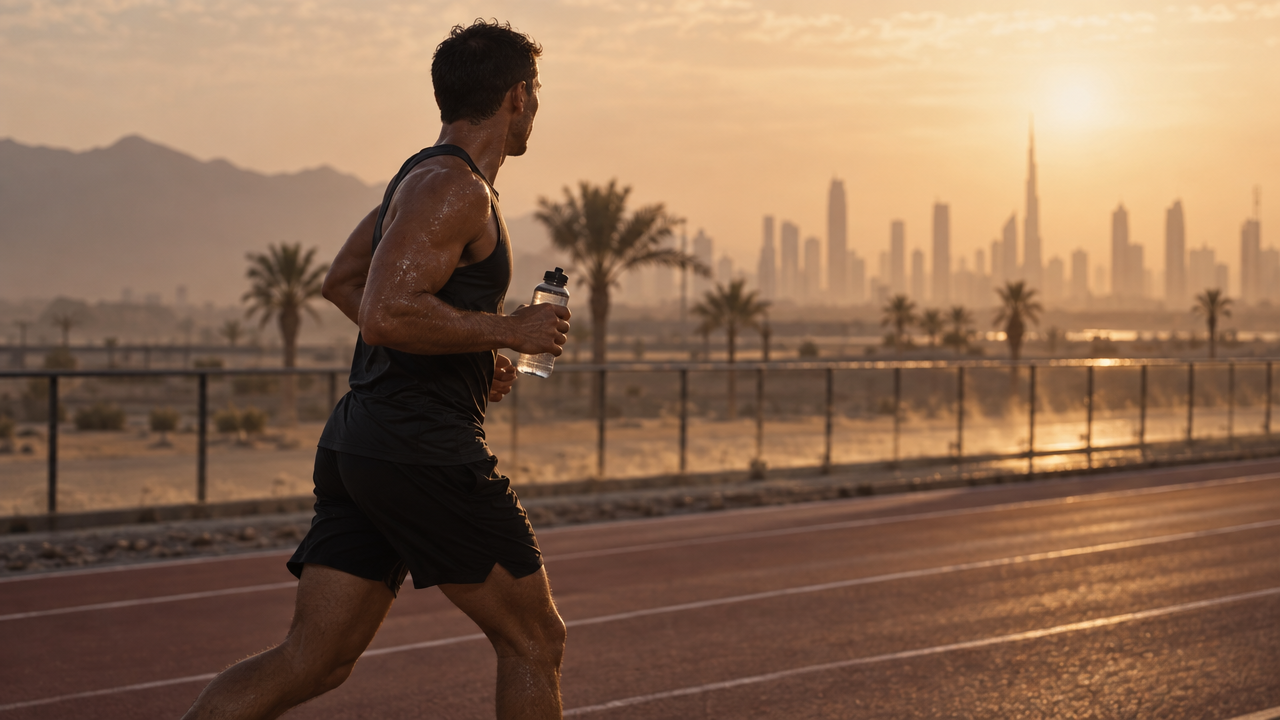
Heat acclimatization is the set of physiological adaptations your body makes when you train repeatedly in hot conditions. For anyone exercising in Dubai, the wider UAE or the GCC, it is one of the most useful pieces of sports physiology you can put into practice.
Heat makes the same session feel harder. Your heart rate climbs faster, your core temperature rises sooner and your pace or power drops. The good news is that the human body adapts quickly and predictably when it is exposed to heat in a structured way.
This guide explains what happens inside your body, how long adaptation takes, how quickly it fades, and how to build a safe, practical heat-training plan.
What Is Heat Acclimatization?
Strictly speaking, scientists use two terms. Heat acclimation describes adaptations gained in artificial settings such as a heat chamber or a hot indoor room. Heat acclimatization describes the same process when it happens in a natural hot climate, for example training outdoors through a Gulf summer. The physiology is very similar, so most coaches use the words interchangeably.
A review in the Scandinavian Journal of Medicine & Science in Sports describes exercise-heat acclimation as a process that induces physiological adaptations that improve thermoregulation and can improve aerobic performance in warm-hot environments, and potentially in temperate conditions too.
The size of the adaptation depends on how hard, how long, how often and how many times you are exposed to heat, and on whether that heat is dry or humid. That last point matters in coastal cities such as Dubai and Abu Dhabi, where humidity can be high.
Key Physiological Adaptations to Heat
According to the same review, the main adaptations include improved sweating, better skin blood flow and fluid balance, lower body temperatures, reduced cardiovascular strain, altered metabolism and enhanced cellular protection.
Lower heart rate and cardiovascular strain
When you exercise in the heat, blood is shared between working muscles and the skin, which needs blood flow to release heat. Acclimatization increases total body water and blood volume, which helps the heart maintain output with less strain at a given workload.
Earlier and more effective sweating
Acclimatized athletes tend to sweat sooner and more, which improves evaporative cooling. Sweat also becomes more dilute. A Gatorade Sports Science Institute review notes that unacclimatized people can lose sweat with a sodium concentration of 60 mmol/L or higher, while after acclimatization it can fall to as low as 10 mmol/L.
Lower core and skin temperatures
With a lower starting temperature and better heat loss, you have more room before core temperature reaches levels that limit performance. This is one reason sessions feel easier after one to two weeks of heat exposure.
| Adaptation | Approximate timeline | Source |
|---|---|---|
| Lower exercise heart rate | Fastest over 4–5 days; essentially complete by about day 7 | Sawka, Périard & Racinais (GSSI) |
| Lower core temperature | Generally complete by 10–14 days | Sawka, Périard & Racinais (GSSI) |
| Most adaptations overall | Develop within the first week | Racinais et al. (BJSM consensus) |
| Recommended programme length | At least 1 week, ideally 2 weeks | Racinais et al. (BJSM consensus) |
How Long Does Heat Acclimatization Take?
The international consensus on training and competing in the heat recommends repeated exercise-heat exposures over one to two weeks, and states that heat acclimatization sessions should last at least 60 minutes per day.
The GSSI review by Sawka, Périard and Racinais suggests that about 7–14 days of heat exposure are usually needed, with a minimum of roughly 90 minutes of daily heat exposure combined with aerobic exercise. This can be extended to about two hours split into two one-hour sessions.
- 1–2 weeks of repeated exercise-heat exposure recommended by the international consensus
- ≥60 min/day minimum heat acclimatization session length (consensus)
- ~7 days for the heart-rate reduction to be essentially complete
- Up to 50% faster adaptation reported in aerobically trained athletes
Fitness matters. Both the consensus and the GSSI review note that aerobically trained athletes can acclimatize faster, in up to about half the time of untrained people. Aerobic training alone, however, is not a substitute for actual heat exposure.
How to Build a Heat Acclimatization Plan
The aim is to create enough heat stress to trigger adaptation without accumulating excessive fatigue or risking heat illness. These principles come from the consensus statement and the GSSI review.
- Start early, ideally two weeks before a hot event or trip, so adaptation is in place before key sessions.
- Train in conditions that resemble your event: similar temperature, humidity and type of exercise.
- Begin with easier, shorter sessions and increase intensity, duration or both gradually each day.
- Aim for at least 60 minutes of exercise in the heat per day, and up to about 90 minutes of daily heat exposure where you tolerate it.
- Keep your normal aerobic conditioning going alongside heat work.
- Eat and drink enough, and prioritise adequate sodium early in the process while sweat is still salty.
Constant work rate or controlled hyperthermia?
Traditional protocols use a fixed pace or power in the heat. Newer controlled hyperthermia (isothermic) protocols adjust intensity to hold a target core temperature. The consensus describes isothermic protocols as controlled hyperthermia to a core temperature of at least 38.5°C. Périard and colleagues note emerging evidence that this method may produce faster and more complete adaptations, although it requires core-temperature monitoring and supervision. If you want supervised progression, personal training in Dubai or online coaching can help you structure this safely.
Training outdoors in the early morning still provides useful heat exposure while lowering risk. Build up gradually, and treat the first hot days of the season, or the first days after travel, as your adaptation window.
Hydration, Cooling and Safety in the Heat
Heat acclimatization works best alongside good hydration. The consensus recommends starting training and competition well hydrated and minimising dehydration during exercise, noting that performance impairment is associated with body water losses of about 2% of body mass or more.
Cooling strategies such as cooling vests before training or competition can also help by increasing heat loss or heat storage capacity. A full review of exercise under heat stress in Physiological Reviews covers heat acclimation, cooling and hyperhydration as the main mitigation strategies.
The ACSM expert consensus describes exertional heat stroke as a true medical emergency. Early recognition, stopping exercise and rapid whole-body cooling are essential. If someone collapses or seems confused while exercising in the heat, call emergency services immediately. Most exertional heat illness can be prevented by recognising and modifying known risk factors. Speak to a doctor before heat training if you have a medical condition or take regular medication.
Does Heat Acclimatization Fade?
Yes. A systematic review and meta-analysis by Daanen, Racinais and Périard found that end-exercise heart rate adaptations declined by about 2.3% and end-exercise core temperature adaptations by about 2.6% for every day without heat exposure.
The same review found that re-acclimation was 8–12 times faster than decay for heart rate and core temperature adaptations, though the authors caution that only eight studies examined re-acclimation. The GSSI review similarly suggests benefits are retained for about one week, with around 75% lost by about three weeks.
In practice, if you travel somewhere cooler for a few weeks, expect to need a shorter top-up block of heat sessions when you return. Heat sessions are also an extra training stress, so plan them alongside your normal approach to exercise recovery and fatigue.
What the Research Still Debates
Not every study agrees on the size of each adaptation. A 2019 meta-analysis of randomised controlled trials by Mohammed Rahimi and colleagues found that heat acclimation significantly improved time-trial performance, but reported no significant change in plasma volume or core temperature across the pooled trials.
Differences in protocols, heat exposure, participants and measurement methods likely explain part of this variation. The practical message is consistent: structured, progressive heat exposure helps performance in the heat, but individual responses differ, so monitor how you feel and adjust.
Key Takeaways
- Heat acclimatization improves sweating, fluid balance and heart rate and lowers body temperature during exercise in the heat.
- Plan for 1–2 weeks of repeated exercise-heat exposure with sessions of at least 60 minutes.
- Heart-rate adaptations come first, mostly within a week; temperature adaptations take 10–14 days.
- Adaptations fade without heat exposure but return faster than they decay.
- Combine heat training with good hydration, sodium intake, cooling strategies and clear safety rules.
Frequently Asked Questions
How many days does it take to acclimatize to heat?
Most adaptations develop within the first week, and the international consensus recommends one to two weeks of repeated exercise-heat exposure. Heart-rate changes are usually essentially complete by about day seven, while core temperature benefits are generally complete by 10–14 days.
How long should heat training sessions be?
The consensus recommends sessions of at least 60 minutes per day. The GSSI review suggests about 90 minutes of daily heat exposure combined with aerobic exercise, which can be split into two sessions.
How quickly do I lose heat acclimatization?
A meta-analysis found heart-rate adaptations fall by about 2.3% and core temperature adaptations by about 2.6% per day without heat exposure. Re-acclimation is faster than the original process.
Does heat training improve performance in cool weather?
Reviews suggest heat acclimation may improve aerobic performance in temperate conditions too, but the evidence is less consistent than for performance in the heat.
Is it safe to train outdoors in the UAE summer?
It can be, with gradual progression, good hydration, cooler times of day and clear stop rules. Heat stroke is a medical emergency, so stop immediately and seek help if warning signs appear, and consult a doctor if you have health conditions.
Sources
- Adaptations and mechanisms of human heat acclimation: Applications for competitive athletes and sports. Scandinavian Journal of Medicine & Science in Sports, 2015.
- Consensus recommendations on training and competing in the heat. British Journal of Sports Medicine, 2015.
- Heat Acclimatization to Improve Athletic Performance in Warm-Hot Environments (SSE #153). Gatorade Sports Science Institute, 2016.
- Heat Acclimation Decay and Re-Induction: A Systematic Review and Meta-Analysis. Sports Medicine, 2018.
- Physiological Responses to Heat Acclimation: A Systematic Review and Meta-Analysis of Randomized Controlled Trials. Journal of Sports Science & Medicine, 2019.
- Exercise under heat stress: thermoregulation, hydration, performance implications and mitigation strategies. Physiological Reviews, 2021.
- ACSM Expert Consensus Statement on Exertional Heat Illness: Recognition, Management, and Return to Activity. Current Sports Medicine Reports, 2021.
Train Smarter in the Heat
Want a heat-smart training plan built around your goals, schedule and climate? Book a free consultation with Mehras Fitness for in-person coaching in Dubai or online coaching worldwide.
This article is for education only and is not medical advice. See our medical & fitness disclaimer.
1 Comments